
AP Physics 1 Practice Questions
20 free AP Physics 1 practice questions with worked answers. Tap an option to check your answer and read the explanation — then get a personalized study plan.
A tube contains a volume of water and a volume of mercury as shown in the figure above. Both ends of the tube are open. Points A and B are at the same level and points C and D are at the same level. The distance between points A and B and the surface of the liquids are shown. Which of the following correctly relates the gauge pressures at the points shown? The density of the water is 1,000 kg/m³ and the density of the mercury is 13,600 kg/m³.

Click to expand
A satellite is in a circular orbit around the earth and moves at a constant speed. If the height of the orbit above the surface of the earth increased (and the orbit remained circular) the kinetic energy of the satellite would

Click to expand
A person is standing in an elevator which is accelerating upwards. Which of the following is true of the person’s apparent weight?

Click to expand
This short set is scored adaptively and keeps its own count. It's separate from the 20 free AP Physics 1 questions on this page, which carry on below.
A block is sliding on an incline with negligible friction as shown in the figure above. At time s the block is moving up the incline with a speed of 1.5 m/s. The magnitude of the acceleration of the block is a constant 1.0 m/s² down the incline. At s, what is the direction of the block’s motion and is the speed increasing or decreasing?

Click to expand
A rock is attached to a 0.4 m long string and is swung through the air so that the path of the rock follows a horizontal circle as shown in the top view figure above. The string makes a 30° angle with the vertical as shown in the side view figure. The rock completes one revolution per second. The speed of the rock is most nearly

Click to expand
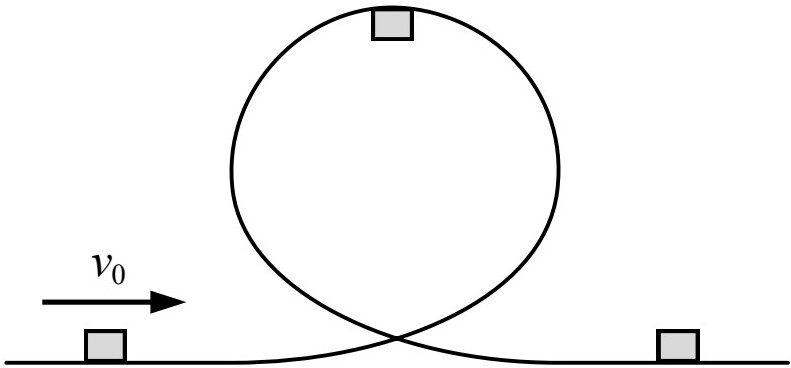
A small block slides along a frictionless track with a vertical loop as shown in the figure above. The block is not attached to the track in any way, but its initial velocity is great enough that it moves through the loop without losing contact with the track. What is the direction of the force exerted on the block by the track when the block is at the top of the loop?
Click to expand
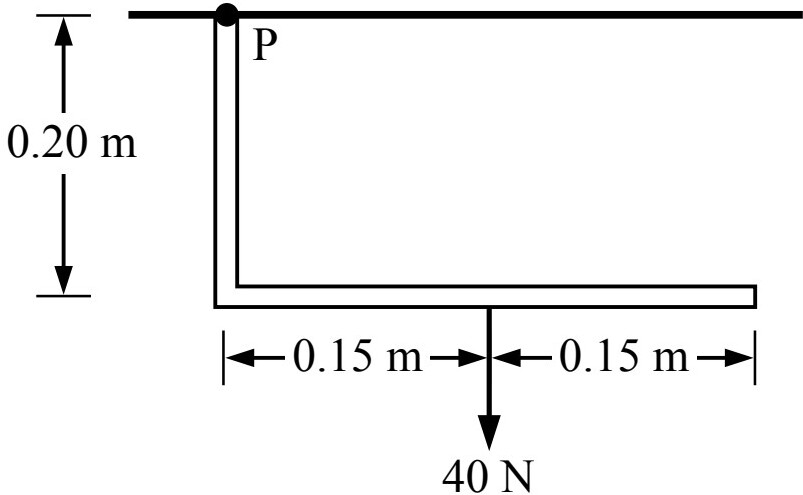
A thin pipe with negligible mass is attached to the ceiling at point P as shown in the figure above. The torque generated at point P by the 40 N force is
Click to expand
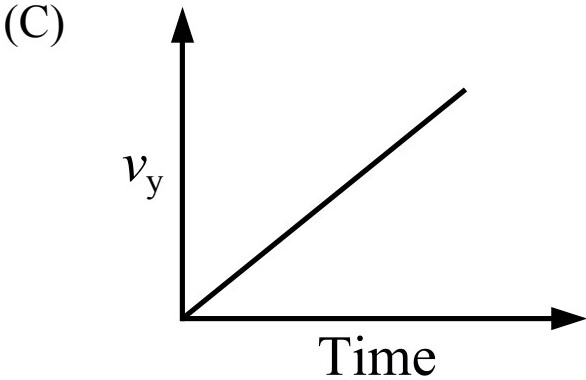
A plane is flying at a constant horizontal speed and is carrying a box as shown in the figure above. It then releases the box which falls through the air and lands on the ground. Ignoring air resistance, which of the following graphs shows the magnitude of the vertical velocity of the box before it lands on the ground?
Click to expand
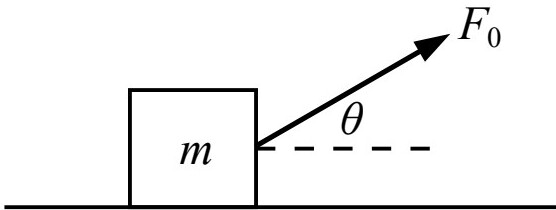
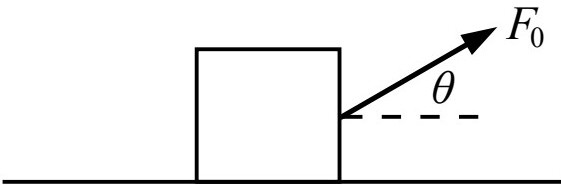
A force is exerted on a block as shown in the figure above. The block accelerates horizontally along the floor and the coefficient of kinetic friction between the block and the floor is . Which of the following is a correct expression for the acceleration of the block?
Click to expand
A force with a magnitude of is exerted on a block as shown in the figure above. There is a friction force between the block and the floor with a magnitude of . If the block remains in contact with the floor, the net force acting on block is
Click to expand
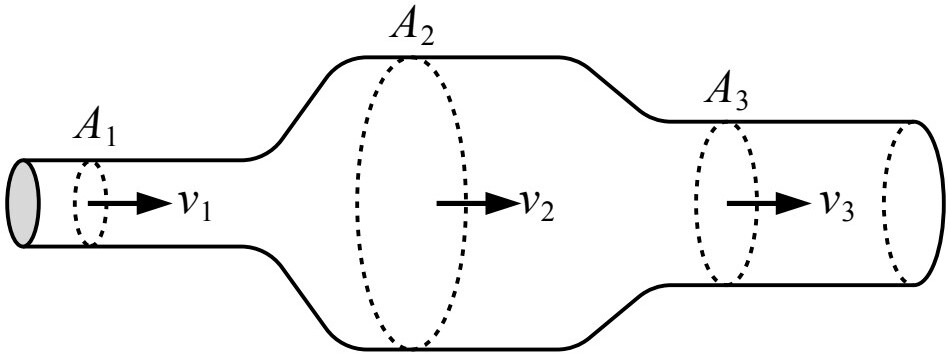
An ideal fluid is flowing through the tube shown in the figure above. Which of the following correctly ranks the speed of the fluid through the three areas shown above?
Click to expand
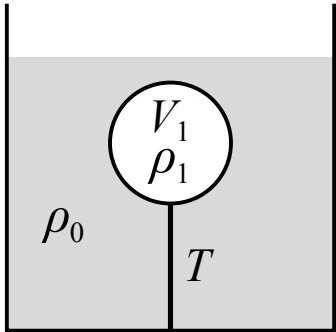
A ball is submerged and floating at rest in a liquid as shown in the figure above. The ball is attached to the bottom of the container by a string. The density of the liquid is , the density of the ball is , and the volume of the ball is . Which of the following is a correct expression for the tension in the string ?
Click to expand
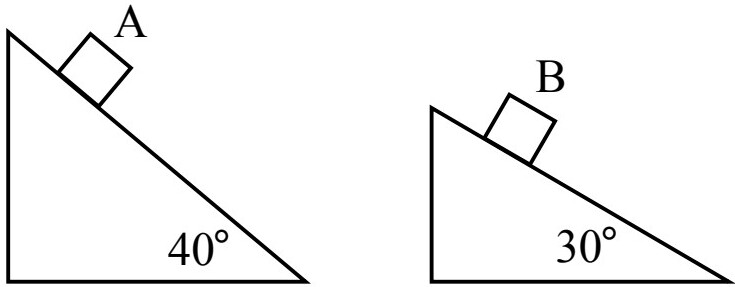
Two identical blocks are sliding down two inclines as shown in the figure above. The coefficient of kinetic friction is the same for both inclines. Which block experiences a friction force with a greater magnitude?
Click to expand
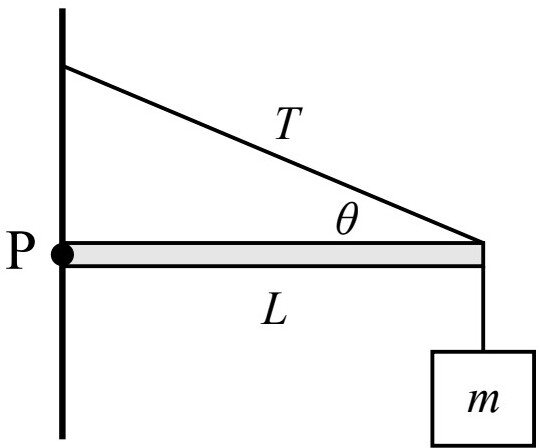
A horizontal pole with a length of and negligible mass is attached to a wall at point where it is free to rotate. At the other end of the pole, a block of mass is suspended by a string with negligible mass and a rope with a tension of and negligible mass connects the pole and the wall at an angle as shown in the figure above. The magnitude of the net torque acting on the pole about point is
Click to expand
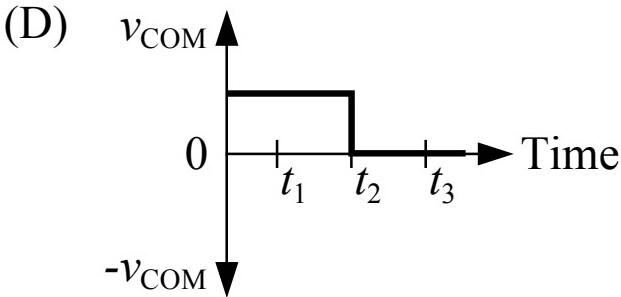
Two blocks are connected by a compressed spring and are sliding together to the right on a surface with negligible friction at time . Some time later at time , the spring expands and pushes the blocks apart. Some time later at time , the blocks are moving in opposite directions. Which of the following could be a graph of the velocity of the center of mass of the blocks-spring system if right is considered the positive direction?
Click to expand
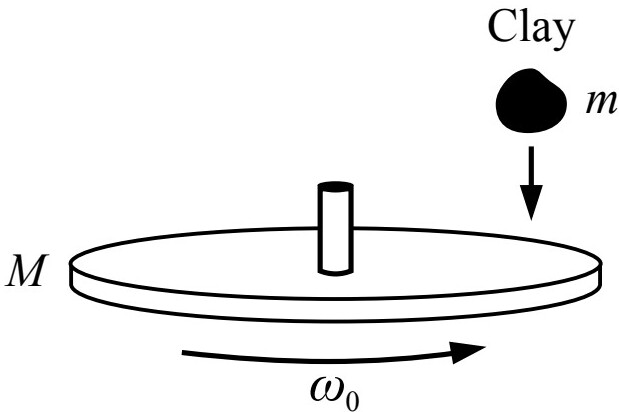
A large wheel is free to spin about an axle passing through its center without friction. The wheel is rotating with a constant angular speed of when a ball of clay is dropped from rest onto the wheel from above and the clay immediately sticks to the wheel at time . Which of the following graphs show the angular momentum of the wheel-clay system about an axis passing through the axle?
Click to expand
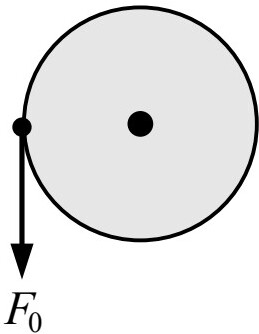
A wheel is initially spinning freely about its center in the clockwise direction with a constant angular speed. A force is then applied to the wheel as shown in the figure above. At the moment the force is applied, which of the following is true about the angular acceleration of the wheel?
Click to expand
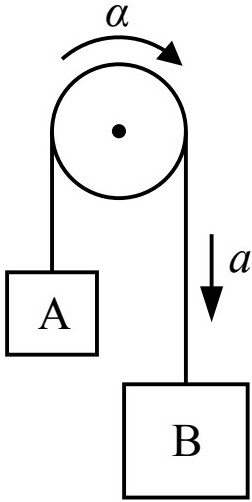
Two blocks are connected by a cable that is wrapped around a pulley as shown in the figure above. Block B has a greater mass than block A so the blocks accelerate and the pulley experiences an angular acceleration (the cable turns the pulley without slipping). If the diameter of the pulley is 0.2 m and the angular acceleration of the pulley is 15 rad/s², the magnitude of the acceleration of the blocks is most nearly
Click to expand
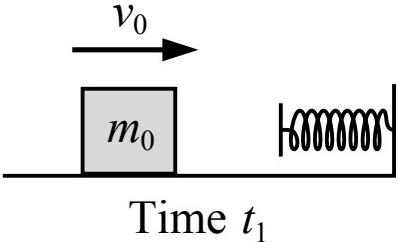
A block is sliding to the right on a surface with negligible friction with a speed of at time . The block then compresses a spring and reverses direction. The block is moving to the left with the same speed of at a later time . The magnitude of the impulse exerted on the block by the spring is
Click to expand
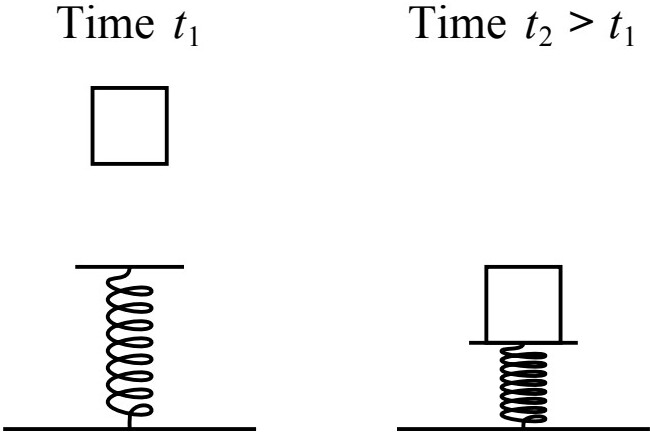
A block is released from rest at a height above an uncompressed spring at time . The block falls and compresses the spring, and momentarily comes to rest at time . Which of the following correctly compares the total energy of the following systems at time and time ?
Click to expand
See exactly where your AP Physics 1 gaps are
Take a free 2-minute diagnostic and Tewtor builds a personalized study plan from your weak spots — scored by the same adaptive engine that powers these questions.
Start freeNo credit card required.